Wednesday, 30 November 2016

Partnership with Talent Vault


Talent Vault and Gander Service Management partner to offer discounted online training to Talent Vault “contractors”.
Talent Vault are all about supporting talented people. When you want the best IT Contractor Specialists, talk to the New Zealand owned and operated recruitment Contractor specialists at Talent Vault.
Courses "Click Here" currently cover:
● ITIL (Foundation - Expert)
● DevOps Foundation
● Certified Agile Service Manager
● OBASHI
● COBIT5 Foundation 
● Business Relationship Management
● Other courses coming soon

Why train online?
Any Talent Vault contractors received a 10% discount of normal price.
● Lower cost – eliminate all travel/hotel expenses and reduce your time away from other priorities
● Any time, any place, any device online access – to all of your training resources and materials
● Focus is on learning – rather than cramming for an exam in a few days, online training focusses on the retention of knowledge
● Courses are guaranteed – no last minute cancellations or re-scheduling
● Content on demand – allows you to pick up where you left off at any time
● Core messages are always consistently delivered to you – regardless of time and location
● Control the pace of the action – you can read, watch, listen and learn as many times as you want during the licence period.
● Make the most your time – by skipping familiar sections that you have already covered and spend more time on re-focussing on other material
● Mixed media repeats the message to you in different formats to stimulate interest and aid retention.
All online courses are offered by IT Training Zone Ltd (ATO)
For more information about Talent Vault or to contact them about this offer please visit their site at http://www.talentvault.co.nz/ 

Friday, 26 August 2016

Classroom training or on-line training?

As you may or may not know, Gander Service Management provides on-line training in many different subjects:

  • ITIL (Foundation through to Expert)
  • COBIT Foundation
  • DevOps Foundation
  • Certified Agile Service Manager
  • OBASHI
  • Business Relationship Management
These are all excellent courses (of course) but you can also get classroom training for most, if not all, in New Zealand.

So which should you choose?  I'll share my personal thoughts and would be grateful for your feedback to let me know if I have missed anything or you feel I am wrong. 

Classroom Training
This is excellent for 
  • those working for organisations where several people need to be trained in the same subject, 
  • training needs to be undertaken within a short time-frame or for
  • those who learn best by being able to discuss subjects with others.
  
If your company decides that they want half a dozen team members trained up, for example in DevOps Foundation, then a classroom training session may be a better solution. If the whole department needs training in the subject, maybe you should engage a training organisation to come on site to perform training  tailored to your organisation.

However, classroom training does cost more to deliver, due to trainer costs, resources, classrooms, lunches, etc. Therefore the cost of classroom training is higher than on-line training.

On-line training
This is ideal for those
  • who wish to invest in their own personal development, 
  • organisations with a small training budget, 
  • organisations away from the larger training centres or where training can be spread over several weeks.  On-line training is generally spread over 30 to 60 days for Foundation level courses, or 90 to 150 days for practitioner level courses.  There are also options to have training packages spread over a year, for example ITIL Expert, where you can take all intermediate training courses and exams for a fraction of the cost of individual courses. (More on that coming soon!)

On-line training also allows you to cover the same areas time and time again until you are comfortable that you understand it, rather than moving at the same pace as the rest of the class.

If you have a limited budget, an on-line course may be a quarter of the cost of a classroom based course due to reduced overheads.  This would allow several of your team to attend a course for the same price as one classroom course.


Of course, there is no wrong or right answer, it has to fit you.  If you learn better in a group, on-line training will not suit you. However, if you are happy learning on your own, you can achieve more training in a year for a fraction of the cost of classroom training.


Find out more about on-line training and costs at www.gander.co.nz/training

Monday, 29 February 2016

The 10 consulting commandments


Image result for stone tablets

A few years ago, I came up with my 10 commandments for consulting.  To be honest they probably make sense for life as well, but we'll stick with consulting here.

I'd be interested to know if you have any others that should be added.


I.  Always listen to the client.  You may need to help them think differently, but you can't understand them if you don't listen.

II. Always consider the impact of what you are doing on others.

III. Never assume that you know better than anyone else. You may have more experience in different areas, or more qualifications, but that doesn't mean you are better or know better. Remember that.

IV. Always be ready to learn something else. There isn't a week go by where I don't stop for a second and realise that I have discovered something new, or experienced a better / different way of approaching something.

V. Share. Share your knowledge and experience with others.  This may be through mentoring  people or just sharing on forums like Back2ITSM

VI. Start the day with a good cup of tea or coffee.  Does wonders for your approach to life.

VII. Be nice to others. Independent consulting is generally about word of mouth, whether that is recommendations or advice to stay away, so always treat people well and be professional.

VIII.  Don't believe EVERYTHING that you read.  If you are going onto a client site to look for improvements for example, then you will need to find out the core information yourself. You can't just take people's word for current state; it may be tainted.

IX. Don't overcharge your clients. This comes back, partially, to commandment VII. Clients are not cash cows.  Yes they may think you are expensive, but they are getting your experience, knowledge and network, to enable work to be undertaken (hopefully) better and quicker than if they were trying to do it themselves. That doesn't mean that you can add hours on here & there to bolster your bank balance.

Image result for me timeX. Always make time for personal development (& holidays).  It can be very easy to get into the "must make money" mindset, but often you will be working harder and longer than full time staff, and so you must make time for a break.  You must also ensure that you have time scheduled into your year for learning.  This may be learning new skills, or new areas of interest, or just improving the way that you think or operate.

Sunday, 6 December 2015

Why we need service desks

On and off over the last few years I have seen a lot of comments in publications, websites and blogs about how new technologies are doing away with Service Desks or stripping away the blockages that IT are perceived to be putting in place.  This frustrates me as its not only IT departments that read this (and some believe it) but the wider business also hears this stuff.   I believe, however, that the exact opposite is true. Service Desks, or a controlled way of providing your end users with the ability to get in touch with IT, are becoming more and more important.

Supporting your end users


If we look at the mention of “new technologies that are doing away with Service Desks”,  those of us at the pointy end of IT are often told “We want to roll out tablets (usually iPads) to all staff in these roles / this level.” Not so bad if you are able to undertake this through a formal project where you can then design the infrastructure, endpoint management, resourcing, etc. prior to the first user turning up to use it.   However, what happens more often than not, is that people turn up with a new iPad  or a new starter wants to connect their tablet to the corporate network and email and find it unreasonable that they can’t just use it.  We’ve all been there, right?  

Take a second to consider this;  The Service Desk receive a request to connect their new tablet to the network and the user is told – usually very nicely - that it’s not allowed (if that is the case).

Who takes the flak? The Service Desk.  

Who makes the decision? CIO? Maybe; Security Manager? Maybe;  IT Operations Manager? Maybe.

It should be a governance group! The governance group or team should represent the business and guide IT on what they should be delivering and focussing on.  If the wider business want IT to allow BYOD then they should direct IT to put in place everything needed to allow it to happen.  COBIT explains it simply in their diagram.

COBIT5 - ISACA


This means that with these new approaches and new technologies that enable staff to work in different ways, the Service Desk is key - maybe more than ever before - to the support of services to staff.  

IT is key to organisations now, and the Service Desk is key to IT.  Everyone in an organisation will at some point or another, talk to the Service Desk. Not everyone will talk to a BRM / SDM or Application support team, or Infrastructure team, or Business Analyst or deskside support, or countless other IT  teams, but they will need to contact the Service Desk.  It may be to get an account unlocked, a new mouse, to complain about the fact that the screen layout on the one thing they use has changed, or to get help changing the password on their iPhone because it doesn’t synchronise with Active Directory and they have the same problem every month.

If you have a company provided user id, email account, PC, tablet, phone, ERP account needed to claim expenses or submit timesheets then you will need to talk to the Service Desk (physically or virtually) to get something fixed, improved or extended.

Or, if we go back to the BYOD example, the company approved the roll out of BYOD. Great.  But to what level?
  • Do you need to provide cloud printing?
  • Do you provide access to email and certain other applications?
  • Who provides the access?
  • Who communicates and explains what can and can’t be done, or how long it takes to get access?
  • Who helps users to connect up when they aren’t sure what to do?
  • Who helps users to use the applications that they want to use?  

BYOD doesn’t take away the need for a Service Desk. It could be seen to increase the interaction.

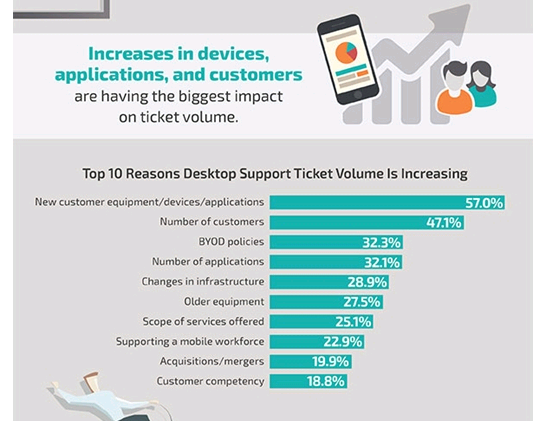
According to HDI, BYOD popularity is growing, yet so are ticket numbers, and BYOD is a big contributor to that.


Service Desks and the rest of IT


Service Desks are critical to all IT departments just like IT is critical to most organisations.  So why is the Service Desk thought to be dead or dying?

Most of the time, I believe the Service Desk gets bad press because it is what most users equate with IT.  So where does this bad rap come from?


Quite often,not always, the Service Desk gets hit with the big stick because they are the front door to IT.   You blame what you can see. Ask airport check-in staff what type of customer interaction they have when flights are delayed. It’s the same reason.

Service Desk get blamed because a user can’t have a shiny new toy.  Therefore, perception is that the Service Desk are useless. Reality may be that Governance is poor.

Service Desk get blamed for new applications not working very well. Therefore, perception is that the Service Desk are useless. Reality may be that a project didn’t test fully before releasing into production.

However, if your customers or users perceive that the Service Desk provide poor service, that is their reality.  That is what you need to change.

I’ll cover ways you can change this in my next post.

Friday, 29 May 2015

Making the most of your supplier relationship

In business, we all have suppliers. Whether they supply the transport to shift your goods from place to place or supply you with equipment, services or people, we all have them.  Your business relies on these people or organisations, but do we all know how to manage the relationship?  

Supplier or Partner?

Make a decision as early in the relationship as possible, whether you have a supplier / customer relationship or a partnership. A partnership will, like all partnerships, require involvement from both sides but should be a lot more fulfilling. You may be expected to share more about your future plans so that your partner can anticipate your needs and help you deliver.  If your relationship is customer / supplier based it will likely be more transactional and not deliver the same overall value to your organisation. However, each relationship should be evaluated individually as on occasion you only need a supplier.

Set expectations

Once you have decided upon the type of relationship, make it clear at the outset. If you want a partnership and the other party is not ready for that, it’s better to know early. Likewise, if you are just looking for a transactional relationship, but the other party assumes a partnership, that too can get awkward.  Clarity early on saves time and embarrassment later.

Meetings

This is where any similarity to a personal relationship will probably disappear. To avoid any surprises, it’s best to make sure you have regular, pre-planned meetings with set agendas, as well as informal meetings.  These informal meetings could be phone calls, coffee or whatever suits, but a brief chat about how things are progressing could save a large amount of disappointment or embarrassment later.
Image result for supplier meetings

Minutes

Ensure that the formal meetings are minuted. I would recommend that the customer minute these meetings so that there is no misunderstanding about actions and timeframes. Of course this will depend on your trust and relationship, but I have seen and experienced meetings where suppliers fail to document some of the more uncomfortable actions so that they get additional time the following month.  Any actions need to be clear, with agreed owners and agreed upon delivery dates.

It is also vital that minutes are circulated as soon after the meeting as possible, and that the agenda for all meetings includes a review of actions. Otherwise, why bother?

Keep the relationship as intended.

Obviously there may be occasions where a relationship changes from one type to another, and that is fine if both parties agree to it, but when it doesn't, you need to remember to keep things as they are supposed to be.  I would strongly recommend against conducting business when invited to events.  The provision of access to events can sometimes be used to influence decision making within customer / supplier relationships. It is often a different matter with partnerships, as it is in both party’s interest to be open and concentrating on the same outcomes.

So these pointers may seem overkill but by being clear throughout the relationship it can save those uncomfortable moments where one or both sides have failed to deliver something. However by following these tips, you will likely never need to revert to contract waving or termination.  That rarely adds value for either party.